
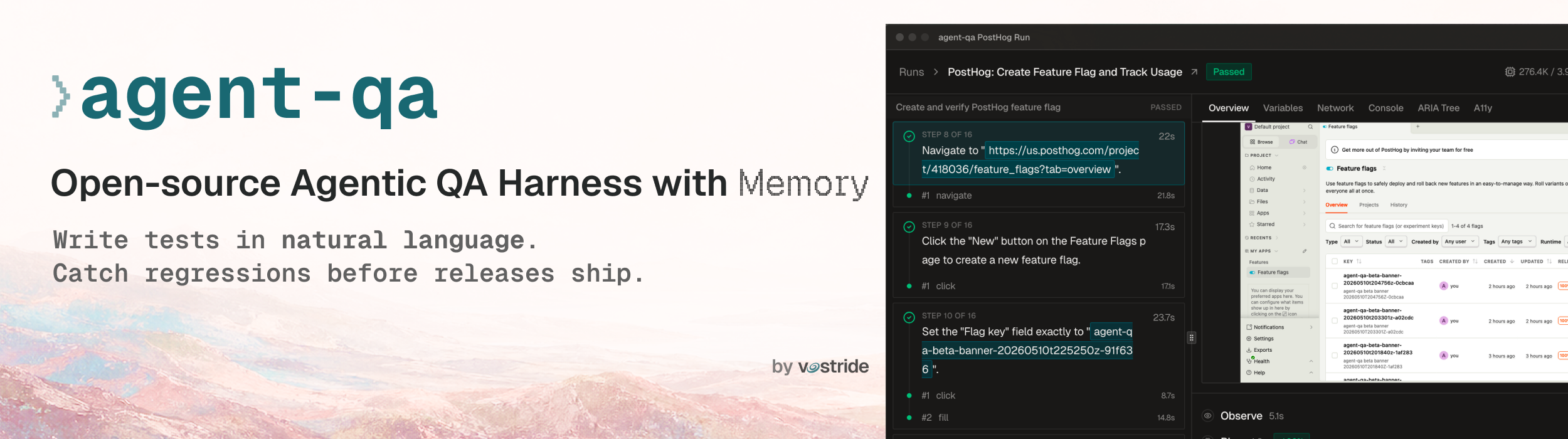



The self-improving Agentic QA harness with Memory
Write tests in natural language for web and mobile. agent-qa learns from past runs, adapts to UI changes, and catches regressions before you ship.
- Write tests in natural language for web and mobile: Define actions and assertions in human language while agents work from visible roles, labels, and screen state.
- Self-healing test execution: When any sub-action, such as click, fill, or select, fails, agent-qa re-observes the UI and tries a different path in the same run. Tests recover from UI drift and flaky interactions instead of failing on the first broken action.
- Self-improves with Memory: With every test run, agent-qa builds execution memory from product, suite, and test observations, then adds that context to future runs. agent-qa also curates memory from steps that were healed during execution, helping future runs avoid the same mistake.
- Built for humans and machines: A polished dashboard and CLI for developers, plus MCP and skills for coding agents.
- Accelerate runs with smart Cache: The action cache reuses validated plans across similar subsequent test runs, reducing planner work, token usage, and runtime overhead.
- Run sandboxed hooks during tests: Run Node, Bun, Python, or Bash hooks in isolated Docker containers to set up environments, call APIs, seed fixtures, tear down state, or pass structured outputs back into the active test run.
- Open source, reviewable QA: The harness is open source, and tests, configs, hooks, memory, and suite logic all live as version-controlled code, so every change can be diffed, reviewed, reused, and shared across teams.
- Bring your own LLM: Run tests with the model of your choice via OpenAI- and Anthropic-compatible endpoints, Gemini, local or open-source models, and subscriptions like Codex and Claude Code.
Node.js 24 or newer (npm comes with it).
npm install -D agent-qa @vostride/agent-qa-subscription-auth
npx agent-qa install-browsers --chromium
npx agent-qa init --llm claude-code
With an API key, install agent-qa alone and pass another --llm value. The rest of the route,
from signing in to a first run of the examples, is in
docs/getting-started.md.
Run tests from the CLI:
npx agent-qa run suites/examples.suite.yamlSet AGENT_QA_LIVE_EVENTS=true and a run prints a machine-readable line-oriented event stream to
stdout, alongside the usual human-readable output. It is off by default, and nothing in
agent-qa turns it on for you: no command, no config key and no child process sets the variable, so a
process that sees these lines is one whose operator asked for them deliberately.
AGENT_QA_LIVE_EVENTS=true npx agent-qa run suites/examples.suite.yamlEvery line has the same shape — the 15-character prefix AGENT_QA_EVENT: immediately followed by
one compact JSON object, then a newline. Nothing else is inserted between the prefix and the JSON,
so a consumer can split on newlines, drop lines that do not start with the prefix, and JSON.parse
the remainder of each one that does.
AGENT_QA_EVENT:{"type":"...", ...}
There are two writers on that prefix, and a consumer will see both interleaved.
| Writer | Source | What it emits |
|---|---|---|
| Run-event reporter | packages/cli/src/reporters/wire-reporter.ts |
One line per run-event envelope — the same envelopes the dashboard and the console reporter subscribe to (run/test/step lifecycle, verdicts, artifacts). The JSON is the envelope itself. |
| Log NDJSON emitter | packages/core/src/logging/log-manager.ts |
One line per log entry, as {"type":"log", ...} — the entry's runId, testId, stepId, level, source, message, data and timestamp. |
Both are armed by the same variable and neither can be enabled without the other: the reporter is
attached to every run session and checks the variable itself on each envelope, and the log manager
is constructed with NDJSON on when the variable is true. Treat the two as one channel with two
record shapes, discriminated by the JSON.
Payloads are printed verbatim, and they are already masked. Only the values in the file
workspace.secretsFile names are secrets, and nothing else is masked. The one exception: the
dashboard's model connection check keeps the key or header value it is testing out of the
provider's error message. Masking happens at the sink that produces each record — envelope
payloads are masked before the reporter sees them, and log entries pass through the same secret
redactor that the human-readable output uses, which replaces each declared value with
[secret:<name>]. This channel performs no second redaction and never
restores an original value, so what a consumer reads is exactly what the run decided to disclose.
Note that the human-readable log display goes to stderr, so redirecting stdout gives you the
event stream on its own.
The channel is supported and stable in this shape. If you consume it, pin on the prefix and on the JSON fields you actually read, not on line ordering between the two writers.
- Full docs
- Quickstart — from an empty directory to a first run
- Re-initializing a workspace from before v2 — what it loses and keeps, and every step
- Claude Code and Codex — the skills and the MCP server in each coding agent
- CLI reference
- Dashboard
- Configuration
- The three queues — run queue, curation queue, agent job queue
- Running agent-qa in CI — what to upload, and what resuming pending work needs
- The authed run service — where the dashboard binds, and how to declare a run-service credential
- License
- Notice